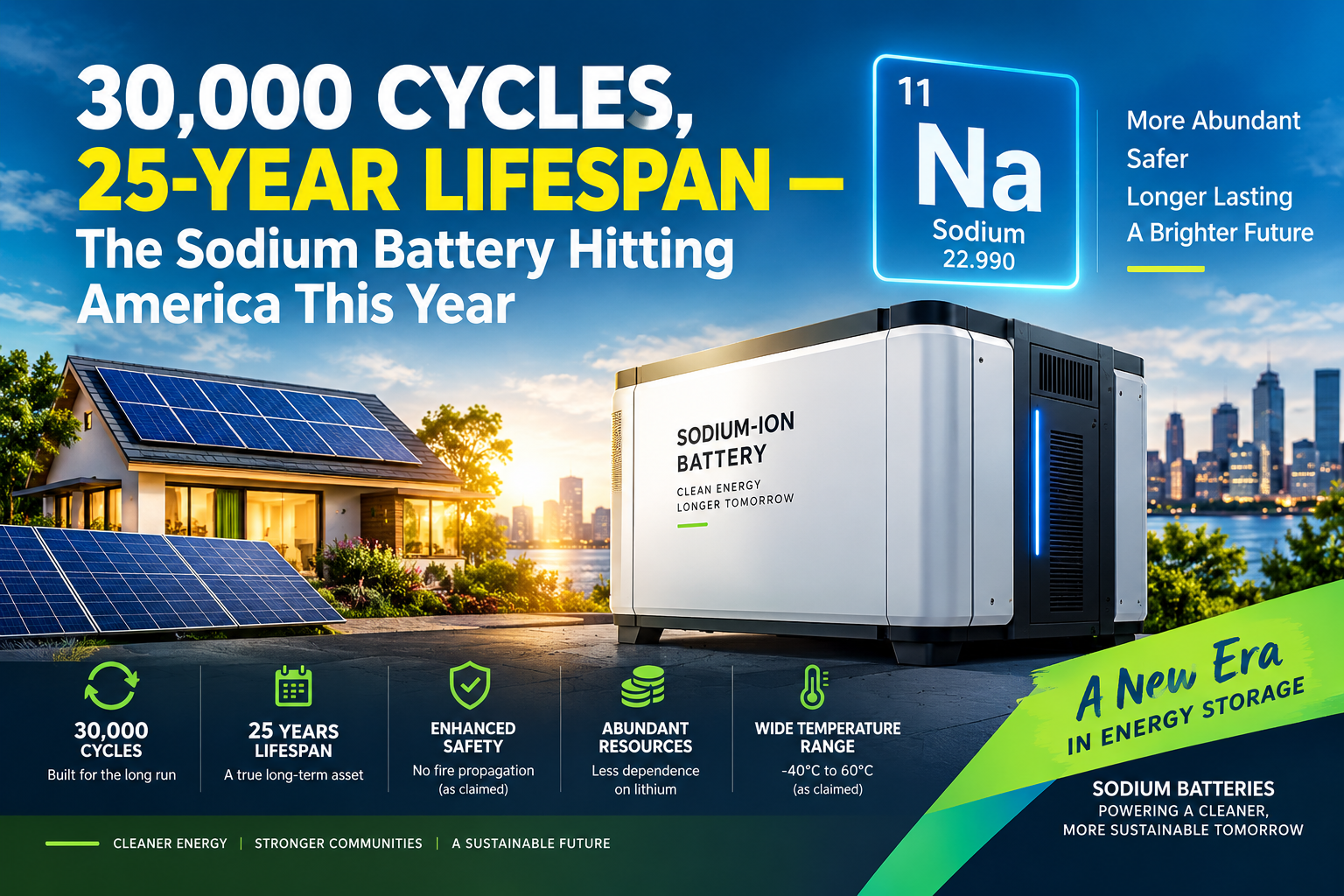
30,000 Cycles, 25-Year Lifespan — The Sodium Battery Hitting America This Year
Sodium-ion batteries are moving from the laboratory into real-world energy storage — and one American battery company is making an aggressive promise: up to 30,000 cycles and a 25-year asset life.
For years, lithium-ion batteries have dominated the energy-storage industry. From residential solar systems and electric vehicles to telecom backup and utility-scale battery storage, lithium has become the default chemistry.
But that dominance is beginning to face serious competition.
A new generation of sodium-ion batteries is entering the market, promising something that could fundamentally change the economics of energy storage: longer service life, improved safety, abundant raw materials and reduced dependence on lithium.
One of the companies attracting attention is U.S.-based UNIGRID, which is developing sodium-chromium-oxide (NCO) batteries for applications ranging from homes to large-scale energy storage.
The 30,000-Cycle Claim
UNIGRID says its NCO sodium-ion technology can achieve up to 30,000 cycles while retaining 80% of its capacity, describing the technology as capable of becoming a 25-year energy-storage asset rather than a replacement-cycle product.
That number is enormous.
Consider a battery that completes one full equivalent cycle every day.
A 3,000-cycle battery would theoretically provide about 8 years of daily cycling.
A 10,000-cycle battery represents roughly 27 years of daily cycling.
At 30,000 cycles, the mathematical equivalent is more than 82 years of daily cycles.
Of course, real-world battery life cannot be calculated from cycle count alone. Temperature, depth of discharge, charging rates, operating conditions and calendar ageing all matter.
But the significance of the 30,000-cycle claim is clear: the battery is being designed around extremely high-cycle stationary storage applications.
Why Sodium Instead of Lithium?
The basic idea is surprisingly simple.
Lithium is valuable because it enables batteries with excellent energy density. But lithium resources, processing capacity and supply chains have become strategically important to the global battery industry.
Sodium is different.
It is far more abundant and does not require the same dependence on lithium resources.
Sodium-ion batteries therefore offer an opportunity to diversify the battery supply chain while potentially reducing exposure to lithium-price volatility.
The technology is also becoming increasingly commercial.
In 2025, CATL announced Naxtra, which it described as the world's first mass-producible sodium-ion battery. In 2026, CATL also unveiled its TENER Sodium energy-storage system, demonstrating that sodium-ion technology is expanding beyond laboratory demonstrations into large-scale storage.
America Is Getting Sodium Storage
This is where the story becomes particularly interesting.
UNIGRID has announced commercial sodium-ion products for the U.S. market, including residential energy-storage technology.
Its product lineup includes the Na+ Casa, a 48V-class residential storage battery, while the company is also developing modules for commercial and grid-scale applications.
UNIGRID says its sodium-ion technology operates across approximately -40°C to 60°C, with passive thermal management rather than relying on conventional active cooling.
That could be particularly important for energy storage.
A battery that requires less thermal-management infrastructure can potentially reduce system complexity, auxiliary energy consumption and installation constraints.
Safety Could Be Another Major Advantage
Battery safety is becoming one of the most important considerations in the energy-storage industry.
Lithium-ion systems can experience thermal runaway under certain failure conditions, which is why modern battery-storage installations increasingly incorporate sophisticated battery-management systems, thermal monitoring, cooling systems and fire-mitigation strategies.
UNIGRID says its NCO sodium-ion technology is designed around intrinsic safety, with no fire propagation under its stated testing conditions. Its batteries have also undergone standards-related testing including UL 9540A at the cell level.
Syntropic Power is also commercializing sodium-chromium-oxide storage systems in North America and reports third-party testing of its NCO cells, including UL 9540A cell-level testing.
This does not mean every sodium battery is automatically fireproof.
Different sodium-ion chemistries have different characteristics, and system-level certification still matters.
But the direction is clear: battery manufacturers are trying to make energy storage safer as well as cheaper and longer-lasting.
The 25-Year Battery Could Change Solar Economics
This may be the most important part of the story.
Solar panels can remain productive for decades.
A modern photovoltaic system can therefore become a long-term infrastructure asset. But if the battery needs to be replaced multiple times during the life of the solar installation, the economics become more complicated.
Imagine a solar system designed to operate for 25 years.
If the battery lasts only 7–10 years, the owner could potentially need one or more major battery replacements.
But if a battery can genuinely operate for decades with extremely high cycle life, the economics change.
Instead of asking:
"How much will my battery replacement cost?"
the conversation becomes:
"How much energy can this battery deliver over its entire operating life?"
That is a much more important metric for commercial and residential energy storage.
But There Is a Catch
The headline numbers should not be misunderstood.
30,000 cycles does not mean every sodium battery will automatically last 30,000 cycles.
The actual lifespan depends on the specific cell chemistry, operating conditions, depth of discharge, temperature, charging/discharging rate and system design.
There is also a major distinction between cell-level performance and the performance of a complete battery system.
In addition, sodium-ion batteries generally have lower energy density than the best lithium-ion technologies.
That means sodium may not replace lithium everywhere.
For applications where weight and physical size are critical — such as long-range electric vehicles — energy density remains extremely important.
But stationary storage is different.
A home battery, telecom battery or grid-scale storage system does not need to travel hundreds of kilometres.
It needs to be:
* Safe
* Affordable
* Reliable
* Long-lasting
* Easy to maintain
* Resistant to temperature extremes
* Economical over its entire lifecycle
And these are exactly the areas where sodium-ion technology is becoming increasingly attractive.
Sodium vs. Lithium: The Battle Is Changing
The future probably isn't going to be a simple situation where sodium completely replaces lithium.
Instead, we could be entering a multi-chemistry battery era.
Lithium-ion — particularly LFP — will remain extremely important because of its established manufacturing ecosystem, energy density and proven performance.
Sodium-ion could increasingly take market share in applications where cost, safety, temperature performance, resource availability and cycle life are more important than maximum energy density.
CATL itself describes the emerging market as a dual-chemistry ecosystem in which sodium-ion and lithium-ion batteries complement each other.
What This Means for Solar Installers
For solar engineers and installers, this development deserves serious attention.
If sodium-ion batteries achieve the advertised combination of long cycle life, safety and competitive pricing, they could become particularly interesting for:
Residential solar
Long-life batteries could reduce the frequency of battery replacement and improve the economics of solar-plus-storage systems.
Telecommunications
High-cycle, temperature-resistant storage could be valuable for telecom towers operating in difficult environments.
Commercial & Industrial Systems
Businesses requiring daily cycling could benefit from batteries designed around extremely high cycle counts.
Mini-Grids
For African markets, where battery replacement and logistics can be expensive, long-life storage could be particularly attractive.
Utility-Scale Storage
Grid operators increasingly need batteries capable of frequent cycling for peak shaving, frequency regulation, renewable-energy integration and grid balancing.
And This Could Be Important for Africa
For countries such as Nigeria, the implications are potentially significant.
Nigeria's solar industry is growing rapidly, but battery cost remains one of the major barriers to widespread adoption of reliable solar-plus-storage systems.
The next major breakthrough may therefore not be another 600W solar panel.
It may be the battery.
A battery that can withstand extreme temperatures, cycle thousands upon thousands of times and operate for decades could dramatically change the economics of distributed energy.
Imagine deploying a solar system today and having a battery designed to remain productive for most of the project's economic life.
That is the kind of technology that could make solar power increasingly competitive with diesel generators and unreliable grid electricity.
The Beginning of a Battery Price War?
There is another consequence that could be even more disruptive.
As sodium-ion manufacturing scales, lithium-ion manufacturers may face increasing pressure to reduce prices.
This could create a new competitive environment:
LFP vs. sodium-ion.
Instead of one dominant chemistry controlling stationary storage, manufacturers could have multiple technologies competing for the same customers.
And when technologies compete on price, performance and longevity, consumers usually win.
The Bigger Picture
The most important development isn't simply that a company is advertising a 30,000-cycle battery.
The bigger story is that sodium-ion technology is becoming commercially relevant.
UNIGRID is bringing sodium-ion products into the U.S. market, while companies such as Syntropic are developing sodium-based residential and utility-scale storage platforms. Meanwhile, CATL is pushing sodium-ion into large-scale energy storage and electric vehicles.
The battery industry is therefore entering an interesting period.
For more than a decade, lithium-ion dominated the conversation.
Now, sodium is knocking on the door.
And if the industry can deliver long cycle life, lower costs and reliable real-world performance at scale, the question may no longer be:
"Can sodium-ion replace lithium?"
The better question could be:
"How much of the energy-storage market will lithium eventually have to share with sodium?"
Final Thought
The energy-storage industry is entering one of its most competitive periods yet.
Lithium isn't dead.
But sodium is no longer just a laboratory experiment.
With commercial products emerging in America, major manufacturers investing in sodium-ion technology and cycle-life claims reaching extraordinary levels, the next few years could determine whether sodium becomes a niche technology — or one of the foundations of the next generation of global energy storage.
The battery revolution may be getting a new element: sodium.
Note: Cycle-life figures are manufacturer claims/specifications and should be evaluated against independent testing, warranty terms, depth-of-discharge conditions and complete-system performance before making purchasing or investment decisions.