
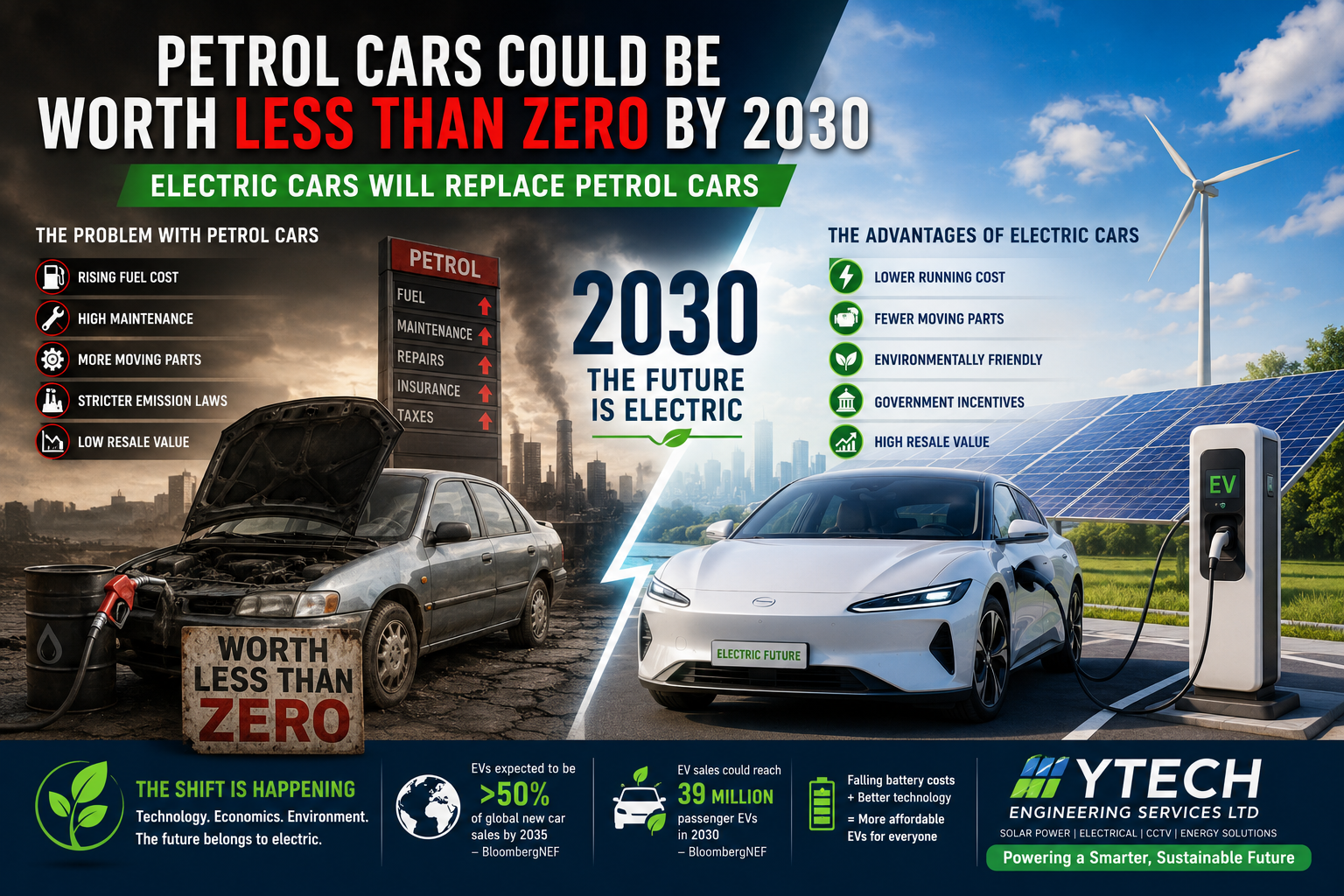
How Your Petrol Car Could Be Worth Less Than Zero by 2030
Imagine buying a petrol car today for ₦15 million.
You maintain it regularly, buy fuel every week, replace engine oil, service the transmission, repair the cooling system and continue paying for increasingly expensive petrol.
Now fast-forward to 2030.
A buyer looks at your petrol car and asks:
Why should I buy this when I can get an electric vehicle with lower running costs and fewer mechanical components?”
That question could fundamentally change the value of petrol cars.
The petrol car may still run perfectly. The engine may still have hundreds of thousands of kilometres left in it. But if demand for petrol vehicles declines while electric alternatives become more affordable, the resale value of some internal-combustion-engine vehicles could fall significantly.
This is why we believe the conversation isn't simply about electric cars replacing petrol cars.
It is about economics replacing old technology.
The Electric Vehicle Revolution Is Already Happening
Electric vehicles are no longer a futuristic concept.
They are already becoming a major part of the global automobile market.
According to BloombergNEF's 2026 Electric Vehicle Outlook, global passenger EV sales are expected to reach approximately 23.3 million vehicles in 2026, representing an 11% increase from 2025. BloombergNEF projects that electric passenger vehicles will surpass 50% of global new passenger-vehicle sales by 2035.
The International Energy Agency (IEA) also expects electric cars to exceed 40% of global new-car sales by 2030 under today's stated policies. Its outlook projects an even higher share in some major markets, including around 80% in China.
This does not mean that every petrol car will disappear by 2030.
There will still be millions of petrol and diesel vehicles on the road.
The important point is different:
The market for new vehicles is gradually moving away from internal combustion engines.
And when the market changes, used-car values eventually follow.
Why Could Petrol Cars Become Much Less Valuable?
There are several forces working against traditional petrol vehicles.
1. Electric Cars Have Fewer Moving Parts
A conventional petrol vehicle contains a complex internal-combustion powertrain.
It has components such as:
* Engine
* Pistons
* Crankshaft
* Spark plugs
* Fuel injectors
* Exhaust system
* Transmission
* Oil pump
* Water pump
* Timing system
* Catalytic converter
* Cooling system
An electric vehicle has a fundamentally different drivetrain.
Instead of burning fuel inside an engine, electricity is stored in a battery and converted into mechanical power through electric motors.
This doesn't mean EVs are maintenance-free. They still require tyres, suspension components, brakes, cooling systems and other maintenance.
However, the drivetrain itself is generally much simpler.
That simplicity can translate into lower routine maintenance requirements and potentially lower operating costs.
2. Fuel Could Become the Biggest Disadvantage
For petrol-car owners, fuel is a recurring expense.
You don't buy petrol once.
You buy it again and again.
Every week.
Every month.
Every year.
Now imagine comparing two vehicles:
Petrol vehicle
You pay for:
Petrol + engine oil + filters + servicing + mechanical repairs
Electric vehicle
You primarily pay for:
Electricity + routine vehicle maintenance
The economics become even more interesting when the electricity used to charge the EV comes from solar power.
This is particularly relevant for countries such as Nigeria, where solar energy can provide an alternative source of electricity for EV charging.
Imagine charging your vehicle during the day using electricity generated from your own solar installation.
Instead of continuously purchasing petrol, part of your transportation energy could come from sunlight.
That is where solar energy and electric mobility begin to intersect.
3. Battery Technology Is Improving
The battery is the heart of an electric vehicle.
For years, one of the biggest arguments against EVs was the cost of batteries.
But battery technology and manufacturing have advanced considerably.
BloombergNEF's outlook highlights falling lithium-ion battery costs and increasing production of more affordable electric vehicles as major drivers of EV adoption.
As battery technology improves, manufacturers can produce EVs with:
* Longer driving ranges
* Faster charging
* Better performance
* Improved durability
* Lower costs
This creates a powerful feedback loop.
Cheaper batteries → cheaper EVs → more EV adoption → greater production → further technological development.
4. Chinese EV Manufacturers Are Changing the Market
One of the biggest developments in the automobile industry is the rapid growth of Chinese electric vehicle manufacturers.
China has become the world's dominant EV manufacturing and sales market.
The IEA reports that China's electric-car sales share could reach around 80% by 2030 under its stated-policies outlook.
BloombergNEF also notes that China has become the only major market where EVs were, on average, cheaper to purchase than comparable internal-combustion vehicles in its 2025 analysis.
This matters for markets such as Nigeria.
Why?
Because Nigerian consumers are highly price-sensitive.
If affordable Chinese EVs continue entering African markets, consumers may begin asking a very simple question:
“Why should I continue buying an expensive petrol vehicle when an electric alternative costs less to operate?”
5. Petrol Cars Could Become Expensive to Operate
The value of a vehicle isn't determined only by its purchase price.
Consider the total cost of ownership.
A ₦15 million petrol car may appear cheaper than a ₦20 million EV.
But what happens after five years?
The petrol vehicle could require:
* Thousands of litres of fuel
* Regular engine servicing
* Oil changes
* Transmission maintenance
* Cooling-system repairs
* Exhaust-system repairs
* Fuel-system repairs
* Other mechanical maintenance
Meanwhile, an EV may avoid many of those engine-related expenses.
This means consumers could increasingly look beyond:
“How much does the car cost?”
and instead ask:
“How much will this car cost me to own?”
That shift could have a major impact on petrol-car resale values.
6. The Used-Car Market Could Change Dramatically
This is where the “worth less than zero” argument becomes interesting.
Suppose petrol cars become less desirable.
Dealers may become more cautious about buying them.
Buyers may negotiate harder.
Financing companies may favour newer and more efficient vehicles.
Some petrol vehicles may become expensive to maintain relative to their market value.
At that point, you could have a situation where:
The cost of keeping the vehicle is greater than the economic value you receive from owning it.
The car isn't literally worth negative money.
Instead, its net economic value could become negative.
For example:
> Vehicle resale value: ₦3 million
> Expected repairs and maintenance: ₦2 million
> Fuel expenditure: ₦2.5 million
> Insurance, taxes and other costs: ₦500,000
>
> The vehicle may technically be worth ₦3 million, but its ownership economics could be unattractive.
This is what we mean when we say a petrol car could become “worth less than zero” economically.
7. EVs Could Eventually Change What We Consider a “Good Car”
For decades, a good car was often judged by:
* Engine size
* Horsepower
* Fuel consumption
* Transmission
* Reliability
* Brand
* Mileage
Electric vehicles introduce a different set of priorities.
Consumers increasingly care about:
* Battery capacity
* Driving range
* Charging speed
* Battery warranty
* Software
* Energy efficiency
* Vehicle connectivity
* Driver-assistance technology
The automobile is becoming less like a purely mechanical machine and more like a mobile energy and technology platform.
8. The Future of Transportation Is Also an Energy Question
At Ytech Engineering Services Ltd, we see another important part of this transition.
Electric vehicles need electricity.
And electricity needs infrastructure.
This creates an opportunity for the renewable-energy industry.
Solar power can potentially support:
Solar PV → Inverter → Battery Storage → EV Charger → Electric Vehicle
Instead of importing fuel to power a vehicle, electricity can be generated locally.
For businesses, homes, offices and commercial facilities, this could eventually create integrated energy systems where solar power supports both building electricity consumption and electric vehicle charging.
What Does This Mean for Nigeria?
Nigeria's transition to electric mobility will not happen overnight.
There are real challenges.
These include:
* Limited public charging infrastructure
* Electricity reliability
* High upfront EV prices
* Battery replacement concerns
* Limited consumer awareness
* Availability of spare parts
* Technician training
* Financing
* Importation costs
These challenges are significant.
But they don't necessarily stop the transition.
They simply mean that Nigeria's transition may follow a different path from Europe, China or North America.
In Nigeria, solar-powered EV charging could become particularly important.
A home or business with solar PV and battery storage could potentially use excess solar energy to charge an EV rather than relying entirely on the public electricity grid.
This is one of the areas where renewable energy companies can play a major role in the future of transportation.
Will Petrol Cars Completely Disappear by 2030?
No.
That would be an unrealistic claim.
There will still be a huge number of petrol and diesel vehicles operating in 2030.
The IEA's outlook itself shows that even as EV adoption rises rapidly, the global vehicle fleet will remain mixed for many years.
The important change will be the direction of the market.
More electric vehicles will enter the road.
More charging infrastructure will be built.
More manufacturers will produce EVs.
More consumers will become familiar with electric mobility.
And the economics of vehicle ownership will continue to evolve.
2030 May Not Be the End of Petrol Cars — It Could Be the Beginning of Their Decline
The biggest mistake would be to think:
“Petrol cars will disappear in 2030.”
The more realistic statement is:
“By 2030, electric vehicles could become sufficiently widespread that owning certain petrol vehicles becomes increasingly difficult to justify economically.”
BloombergNEF's 2026 outlook places the global milestone of electric passenger vehicles exceeding 50% of new sales around 2035, while its 2025 outlook projected approximately 39 million passenger EV sales in 2030.
That is a massive transformation of the automotive market.
And once EVs dominate new-car sales, the used-car market will eventually feel the effect.
The Real Question Is Not “Will Petrol Cars Die?”
The better question is:
“How quickly will the economics of electric vehicles become impossible to ignore?”
Technology doesn't always replace an older technology because the old technology stops working.
Sometimes it replaces it because the new technology becomes:
* Cheaper
* More efficient
* Easier to operate
* More convenient
* More technologically advanced
* More environmentally acceptable
That is exactly what could happen with electric vehicles.
Your petrol car may still start every morning in 2030.
But the question could be:
Will people still want to buy it?
The Future Is Electric — And It Needs Energy Infrastructure
The transition to electric mobility will create an entirely new ecosystem.
We will need:
EVs + Charging Stations + Solar Power + Battery Storage + Smart Energy Management
This is where companies like Ytech Engineering Services Ltd can contribute.
As a renewable-energy and electrical engineering company, we believe the future isn't simply about installing solar panels.
It is about building integrated energy systems that can power homes, businesses, industries and eventually electric transportation.
From solar PV systems and battery storage to electrical infrastructure and future EV charging solutions, the energy landscape is changing.
Final Thoughts
The petrol car isn't going to disappear overnight.
But its dominance is being challenged.
Electric vehicles are gaining market share. Battery technology is improving. EV manufacturing is scaling. Charging infrastructure is expanding. And consumers are increasingly considering the total cost of ownership rather than simply the purchase price.
By 2030, some petrol vehicles could still have substantial value.
Others, particularly inefficient or expensive-to-maintain models, could face significant depreciation.
So when someone says:
“My petrol car will always have value.”
The future may answer:
“Only if someone still wants to buy it.”
The automotive revolution has already started.
The question isn't whether electric cars are coming.
They are already here.
The real question is:
Are you ready for the electric future?
About Ytech Engineering Services Ltd
Ytech Engineering Services Ltd provides professional renewable-energy and electrical engineering solutions, including solar power systems, battery storage, electrical installations, CCTV/security systems, maintenance and related energy solutions.
We are committed to helping homes, businesses and organisations prepare for a more reliable, efficient and sustainable energy future.
Ytech Engineering Services Ltd — Powering a Smarter, Sustainable Future.